Most organisations have a competency framework. Few can honestly say their leaders care about it.
This is not a communication problem. It is not a training problem. It is a design problem. And it sits at the heart of why so many leadership development programmes fail to move the needle on the behaviours they were built to change.
A senior leader at one of India’s most respected conglomerates recently shared his organisation’s competency framework. It had been developed with a leading global consultancy. The behaviours were precisely articulated. There were playbooks for how the framework should show up in meetings, in appraisals, in goal-setting conversations. Twelve pages of detailed guidance. Thoughtfully constructed. Genuinely impressive.
His assessment of where the organisation actually stood against it was three words: take the opposite.
The framework was not wrong. It was simply never internalised. It lived in documents, not in people.
The Problem with Imposed Frameworks
Why leaders file competencies rather than live them
Competency frameworks typically describe what the organisation values. But when they arrive as an external construct—handed down from HR, aligned to a strategy the frontline had no hand in shaping—they trigger a predictable response. Leaders read them, acknowledge them, and file them. The language belongs to the organisation. The behaviours remain unchanged.
This is not resistance. It is how human development actually works. People do not grow by memorising someone else’s playbook. They grow by building their own—in their own language, from their own experience, toward their own version of what better looks like.
The question for L&D professionals is not whether the competency framework is well-designed. It is whether leaders experience it as part of a journey they are already invested in.
A Different Starting Point
Broad-spectrum development and the SHARP model
At Humanistic, we approach this through what we call broad-spectrum development—developing the whole leader, while creating deliberate space to work on the capabilities the organisation needs most.
The foundation is SHARP: five dimensions—Strengths, Health, Absorption, Relationships, and Purpose—that together constitute the conditions for sustained high performance. What makes SHARP distinctive is not the five dimensions themselves, but the architecture.
From phases to a single expanding journey
Rather than a phase-based progression—lead self, then lead others, then lead the business—SHARP works as a single expanding journey. Personal transformation creates the conditions for team transformation, which in turn shapes business and organisational transformation. Everything grows from the same core.
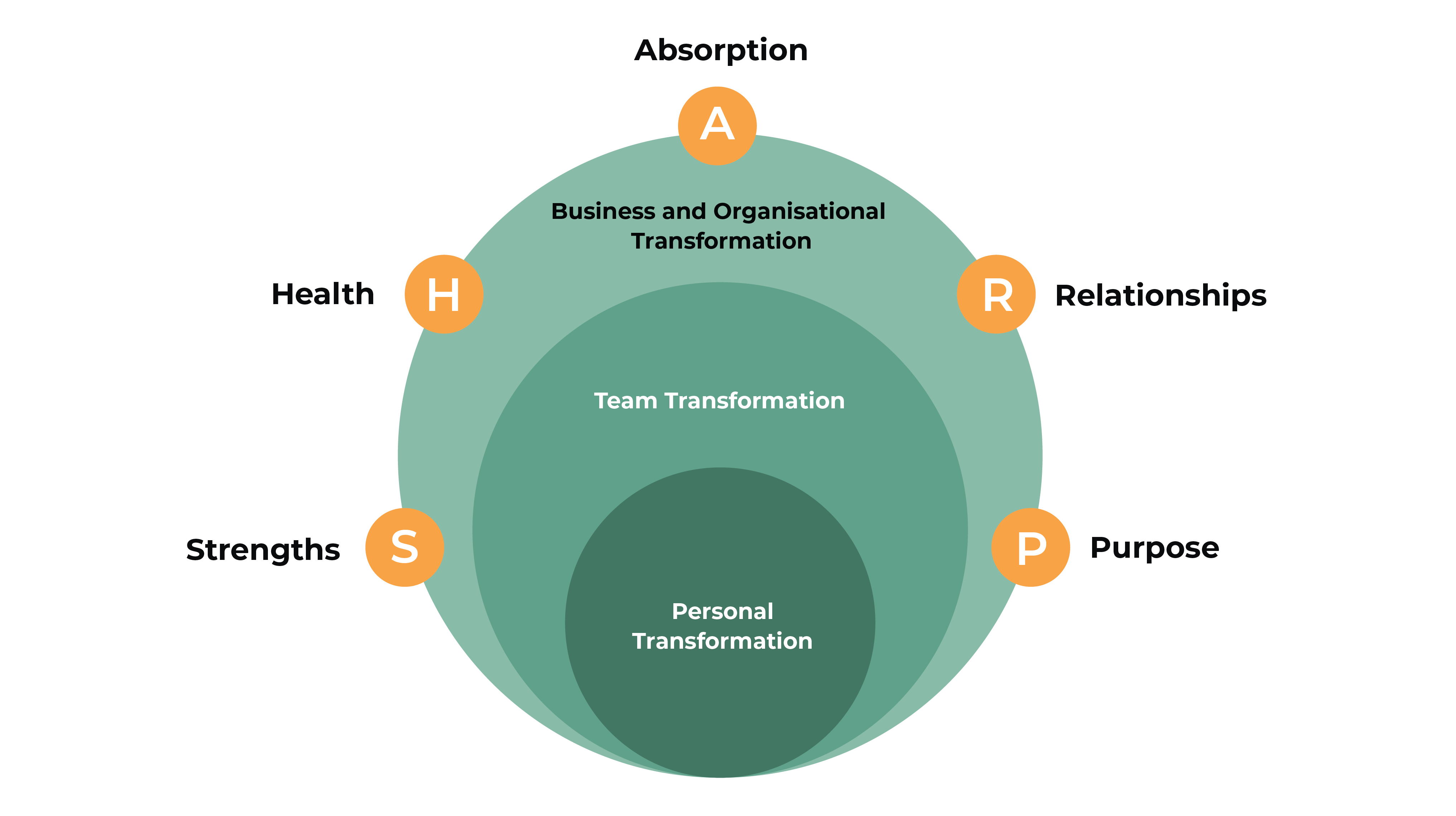
This matters because it changes how competencies land. When a leader is already working on their relationships—examining how they show up, where they hold back, what their default patterns are—introducing a competency around psychological safety or stakeholder influence does not feel like an external imposition. It feels like the next question in a conversation they are already having with themselves.
The Jazz Principle
Why prescribed playbooks don’t stick—and what does
In a jazz ensemble, every musician knows the tune. They know the chords. But within that shared structure, each player improvises—finding their own line, in their own way, responding to what is happening in the room. The music holds together not because everyone plays the same notes, but because everyone understands the same underlying structure.
A symphonic orchestra works differently. It requires years of prescriptive training to perform in one precisely specified way. Most organisations are not in the business of producing orchestras. And yet that is implicitly what most competency frameworks ask leaders to do—learn the score, and perform it as written.
What SHARP creates instead is the conditions for jazz. Leaders work within a shared framework—one they understand and have made their own—while improvising in the language of their own experience. The competency becomes a chord they can play in their own way, not a note they are required to hit exactly.
What This Looks Like in Practice
Competency sprints within a broader development journey
Within a SHARP development journey, organisational competencies can be introduced as focused sprints—specific periods of concentrated attention on a targeted behaviour or capability, embedded within the broader development arc.
The competency is no longer a separate HR construct that leaders are expected to understand and demonstrate. It becomes a chapter in a journey they are already writing.
Flexibility without disruption
This has a practical implication for how development programmes are designed. It is not necessary to rebuild the entire programme every time the organisation introduces a new priority capability or a new cultural behaviour. A well-designed broad-spectrum foundation makes it possible to introduce targeted sprints without disrupting the overall journey—because leaders already have the inner infrastructure to work with new challenges as they arrive.
The Right Question
The question is not whether your leadership programme is aligned to your competency framework. It is whether your leaders experience the two as part of the same journey.
If the answer is no—if the framework lives in documents rather than in people—the problem is not the framework. It is the distance between what the organisation has articulated and what leaders have made their own.
Closing that distance is not a communication exercise. It is a development architecture question. And it starts with creating the conditions for leaders to build their own playbook—in their own language, from the inside out.